A product photo cannot tell you how a mattress will feel. Labels such as plush, medium, and cooling are not universal measurements, so the best choice is the one that matches how you sleep, your preferred feel, room, and budget. Start with personal needs, then compare construction and store policies rather than letting a marketing claim decide the purchase.
Begin With Sleep Position and Preferred Feel
Your usual sleep position is a sensible starting point because it changes where your body applies pressure to the bed. Side sleepers often prefer enough surface cushioning for the shoulders and hips to settle comfortably. A mattress that feels too firm may create concentrated pressure in those areas, while one that is extremely soft may allow the body to sink more than the sleeper likes.
Back sleepers commonly look for a balance: some contouring at the surface with a stable feeling underneath. Stomach sleepers frequently prefer a firmer, less enveloping surface that limits deep sinking around the midsection. Combination sleepers should consider how easily they can turn. A highly conforming foam can feel comfortable while still making movement slower, whereas a more responsive surface may make position changes easier.
These are starting points, not rules. Body weight, body shape, bedding, and preference all influence perceived firmness. A mattress often feels firmer to a lighter person and softer to a heavier person because compression differs. Couples should compare preferences before shopping. Split firmness, adjustable air chambers, or a middle-ground feel can help when preferences differ.
Separate Firmness From Support
Firmness describes the initial feel of the sleep surface, from soft to firm. Support refers to how steadily the mattress resists excessive sinking and keeps the sleeper from feeling unstable. A soft mattress can have a supportive core, and a firm mattress can still be a poor fit if its construction is weak or its shape does not suit the sleeper.
Treat brand firmness scales as rough comparisons. One company’s medium may resemble another’s medium-firm. Read how the comfort layers and core are constructed, then use an in-person test or home trial whenever possible.
Compare Mattress Materials by Their Trade-Offs
No material is automatically best. Construction determines how the components work together, and mattresses within the same category can vary widely.
- Memory foam contours closely and absorbs movement well, but some versions respond slowly or retain warmth. Density, layer thickness, cover fabric, and ventilation affect performance.
- Other polyfoam ranges from cushioning to resilient and appears in comfort layers and cores. Quality varies, so request layer specifications.
- Latex generally feels springier and less enveloping than memory foam, which can ease movement and improve airflow. It may be heavy or expensive; check whether it is natural, synthetic, or blended.
- Innerspring mattresses use coils with limited cushioning. They tend to feel responsive and breathable, while motion control and pressure relief depend on the coil design and comfort layers.
- Hybrids pair substantial foam or latex layers with a coil core. They may balance contouring, airflow, responsiveness, and support, but the category name alone says little about quality.
- Adjustable air beds use air chambers to vary firmness, which can help partners with different preferences. Consider mechanical parts, noise, maintenance, electricity, and warranty coverage.
Evaluate Temperature, Motion, and Edge Support
People who sleep warm should examine the whole design. Coil cores generally permit more airflow than solid foam cores. Latex and responsive foams may feel less enveloping, while deep contouring increases body contact. A cool-to-the-touch cover may create an immediate sensation without controlling temperature all night. Bedding and room conditions also affect warmth.
For couples, motion isolation describes how well the mattress keeps movement from spreading across the surface. Slow-response foam often performs well, while very bouncy constructions may transmit more movement. Test this by having one person change positions while the other remains still. Responsiveness is the other side of the trade-off: more bounce can make turning and getting out of bed easier.
Edge support matters if you sit on the perimeter, sleep near the side, or want to use more of the mattress surface. Sit and lie near the edge during a store test. Stronger edges should feel stable without requiring the perimeter to be rock hard. Remember that a showroom sample may have been used extensively and may not feel exactly like a new mattress.
Test the Mattress Deliberately
A quick sit reveals little. In a store, lie in your normal positions for several minutes each, ideally with a pillow similar to yours. Notice pressure at the shoulders and hips, unwanted sinking, ease of rolling over, and edge stability. Partners should test together.
For an online purchase, the home trial is the real test, but only if its terms are workable. Confirm the trial length, whether there is a required break-in period, who arranges pickup, whether return shipping or collection costs apply, and whether opened mattresses receive a full refund. Check whether the original packaging must be kept and whether the policy allows only one return per household or address. A trial from the manufacturer may differ from the policy offered by a marketplace seller.
Read Warranty and Return Fine Print
A long warranty is not proof that a mattress will remain comfortable for that entire period. Warranties usually address defined defects, not a change in comfort preference or ordinary softening. Read the definition of a covered indentation, whether measurements must be taken without weight on the bed, and whether stains, tears, improper support, or removed labels can void coverage.
Check whether coverage is full or prorated, who pays transportation or inspection costs, and whether a replacement restarts the warranty. Keep the receipt, label details, and photographs. A suitable protector matters because stains can complicate a claim.
Confirm Size, Foundation, and Room Fit
Measure the room, frame, doors, stair turns, and elevator before ordering. Exact dimensions can vary slightly, and extra thickness may affect sheets, headboard proportions, or ease of getting into bed. People or pets sharing the surface may justify more width, while a smaller room needs walking space.
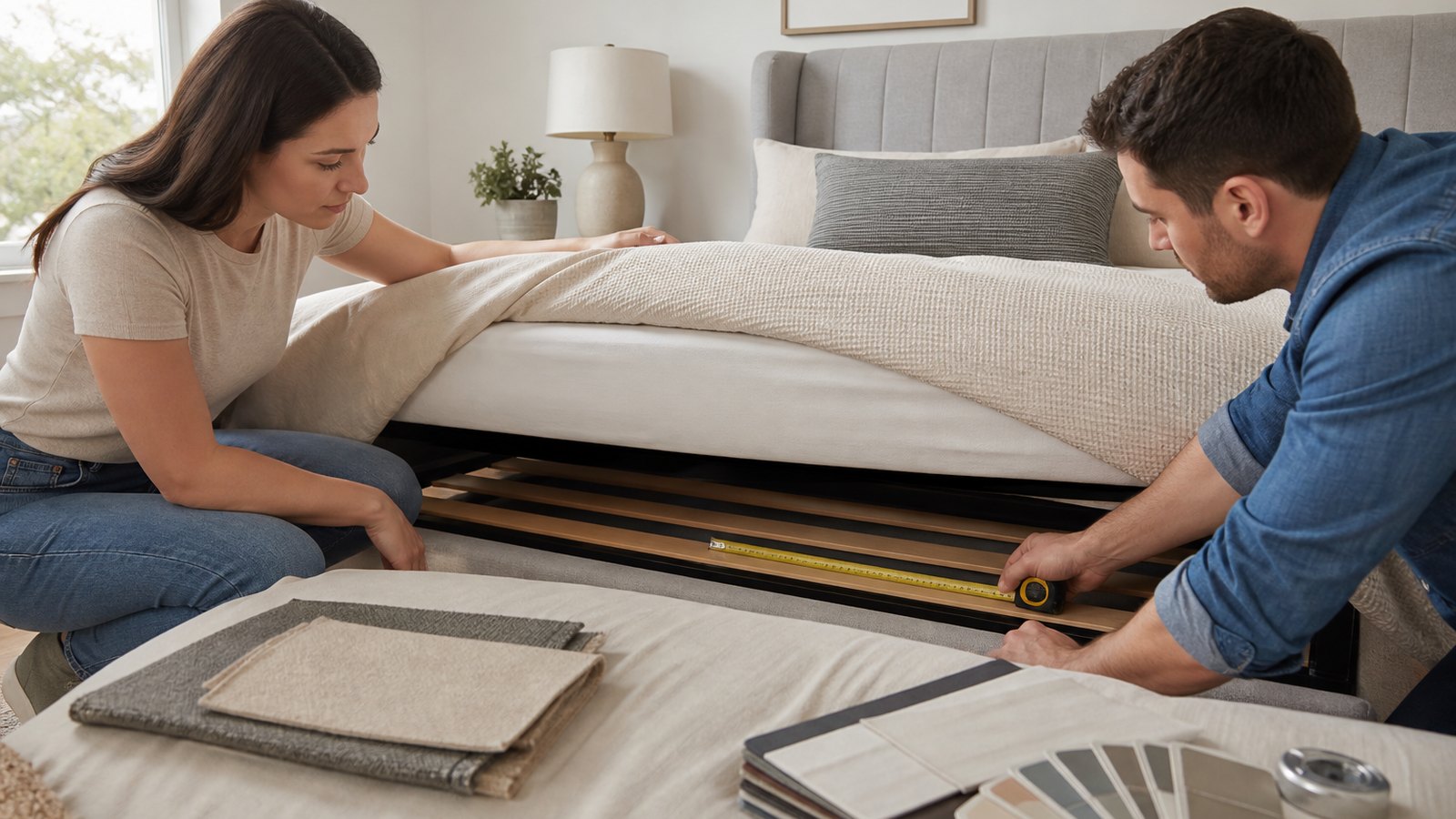
Verify the required foundation. Some mattresses can sit on a solid platform, while others require closely spaced slats or a particular adjustable base. An old box spring may not provide suitable support for a modern foam or hybrid mattress. Follow the manufacturer’s spacing and center-support rules, especially for larger sizes, because an incompatible base can affect feel, durability, and warranty eligibility.
Plan for Delivery and Setup
Before checkout, determine whether delivery ends at the door, reaches a room of choice, or includes setup. A boxed mattress can still be very heavy. Confirm who will move it, stair fees, and whether old-mattress removal is included.
Mattress Buying Checklist
Before placing the order, verify the following:
- Your main sleep position and preferred surface feel
- Both partners’ preferences and sensitivity to movement
- Exact mattress dimensions, height, and room clearances
- Material and layer construction, not just the category name
- Pressure relief, ease of movement, temperature considerations, and edge stability
- Foundation, slat spacing, center support, and adjustable-base compatibility
- Home-trial length, break-in requirement, fees, pickup process, and refund conditions
- Warranty exclusions, indentation threshold, prorated terms, and transport costs
- Delivery location, setup, old-mattress removal, and package handling
- A saved receipt, policy copies, product details, and calendar reminder for the trial deadline