Cookware materials differ in heat response, weight, durability, reactivity, maintenance, and price. No material is best for every dish. A useful collection often combines a few pieces chosen for specific jobs rather than a large matching set. Understanding the construction beneath the marketing makes that choice easier.
Begin with the cooking jobs
List what you cook most: eggs, sauces, rice, soups, seared meat, braises, pancakes, or acidic tomato dishes. Note batch size, oven use, and whether pans move frequently from stove to oven. A responsive pan helps with delicate temperature changes, while heat retention can benefit searing and frying.
Check the cooktop. Induction requires magnetic cookware; a magnet that sticks firmly to the base is a useful initial check, though manufacturer compatibility guidance is better. Flatness matters on smooth electric and induction surfaces. Gas is more tolerant of base shape but can heat handles and sidewalls.
Weight and handle design affect safety. Test an empty pan and imagine it full of food. A helper handle can make a large skillet or Dutch oven easier to lift. Confirm oven-safe temperature limits for the vessel, handle, lid, knob, and coating separately.
Stainless steel
Stainless steel is valued for corrosion resistance, durability, and low reactivity with food. Because stainless steel alone conducts heat relatively poorly, quality pans often bond it to an aluminum or copper core. “Tri-ply” usually describes layers, but it does not guarantee thickness, coverage, or performance. Determine whether the conductive layer runs through the sides or only across a disk on the base.
Stainless steel suits browning, pan sauces, boiling, and acidic foods. It is not naturally nonstick. Preheating appropriately, using enough fat, controlling temperature, and allowing food to release after browning improve results. Burned residue can usually be soaked and cleaned without harming an uncoated surface, subject to the maker’s instructions.
Inspect rim shape, handle attachment, lid fit, and interior corners. Fully clad construction can heat sidewalls evenly but costs and weighs more. A thick base may be sufficient for stockpots where sidewall response matters less.
Cast iron and carbon steel
Cast iron stores substantial heat and works well for searing, frying, baking, and steady cooking. It heats more slowly and can be uneven while warming, so gradual preheating helps. Its weight can be a limitation, and a hot handle requires protection.
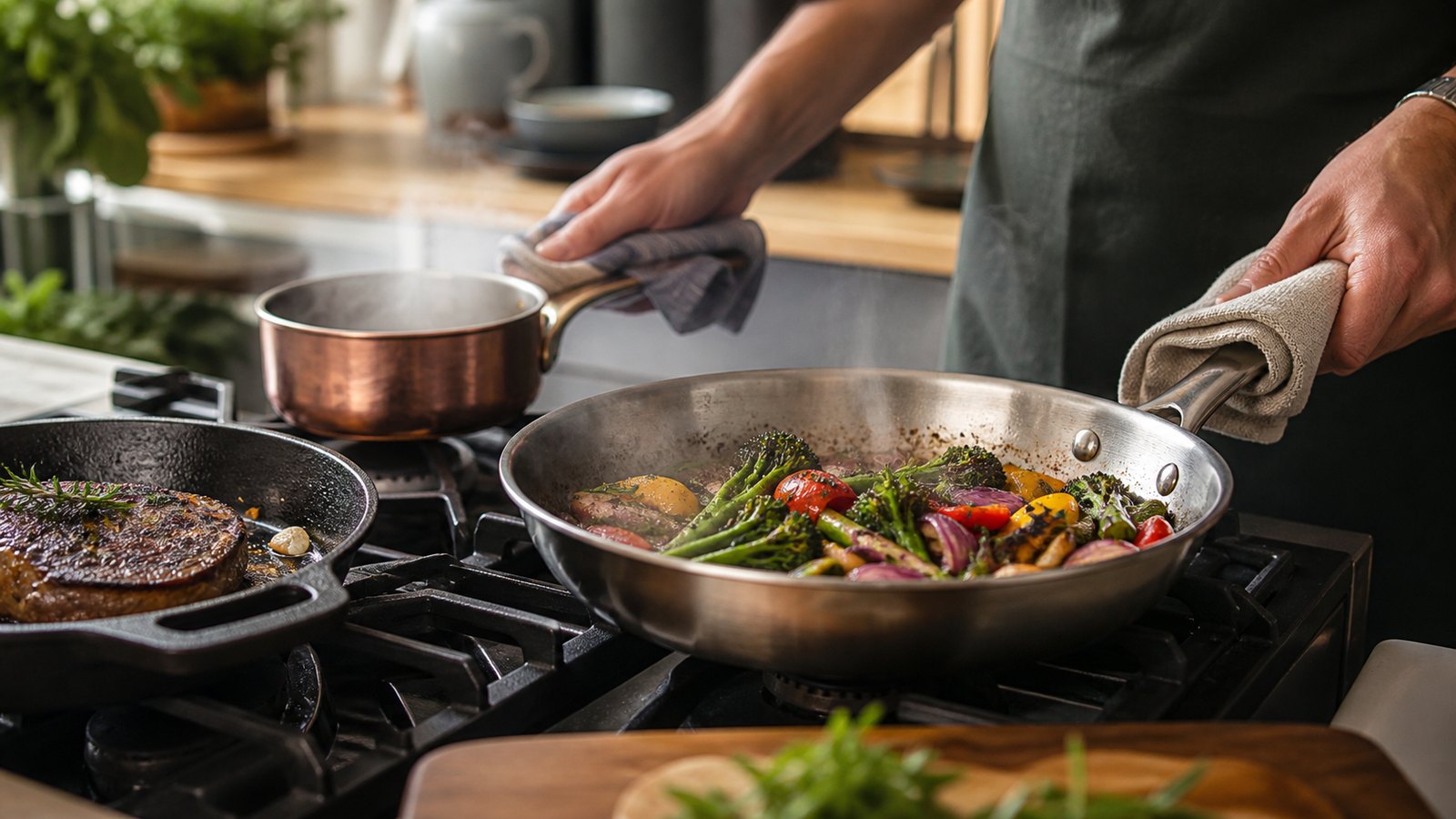
Traditional bare cast iron develops a seasoned surface: thin layers of oil are heated to form a bonded coating. Seasoning improves release and corrosion resistance but is not identical to factory nonstick. Dry the pan promptly and maintain it according to the manufacturer’s guidance. Long cooking of acidic foods can affect seasoning and sometimes flavor, especially on a newer surface.
Enameled cast iron adds a glass-like coating that reduces reactivity and eliminates seasoning. It remains heavy, and enamel can chip or craze if struck or thermally shocked. Inspect used pieces carefully, particularly the cooking surface.
Carbon steel shares many care requirements with bare cast iron but is usually thinner and more responsive. It can warp if heated abruptly or if a hot pan is cooled rapidly. It is popular for skillets, crepe pans, and woks when the cook accepts seasoning and hand care.
Aluminum
Aluminum conducts heat well and is relatively light. Bare aluminum can react with acidic or alkaline foods and may discolor. Anodized aluminum has an electrochemically hardened surface that improves durability and reduces reactivity. Some anodized pans also carry a separate nonstick coating, so identify the actual cooking surface.
Many stainless pans use hidden aluminum layers, gaining conductivity without exposing aluminum to food. Cast aluminum can provide substantial construction at lower weight than cast iron, but quality and coating vary. Check whether an aluminum pan is induction-compatible; it needs a suitable magnetic base.
Copper
Copper responds quickly to heat changes, making it attractive for temperature-sensitive cooking. Because copper can react with food, most general-purpose copper cookware is lined with stainless steel or tin. The lining determines care: tin is relatively soft and has lower heat tolerance, while stainless steel is more durable but changes the pan’s response.
Copper requires polishing only if appearance matters; tarnish does not by itself define cooking performance. Inspect used lined copper for exposed copper on the food-contact surface. Re-tinning is a specialized service and should be included in ownership cost. Most copper is not induction-ready unless built with a magnetic layer or used with an appropriate interface approved for the cooktop.
Nonstick coatings
Nonstick cookware is useful for eggs, pancakes, and other delicate foods with modest fat. Coatings are consumable surfaces, not lifetime materials. Their durability depends on formulation, application, utensils, heat, cleaning, and storage.
Follow the manufacturer’s maximum temperature guidance, ventilate the kitchen, and avoid leaving an empty coated pan over high heat. Use compatible utensils and cleaning methods. Replace cookware when the coating is peeling, flaking, deeply scratched, or no longer functions as intended.
“Ceramic nonstick” commonly refers to a silica-based coating rather than a solid ceramic pan. It can provide good initial release but may lose performance with use. Marketing words such as “stone,” “granite,” or “diamond” may describe appearance or additives; they do not identify the full construction or prove durability.
The FDA regulates substances used in food-contact applications, but shoppers should still buy identifiable products from accountable sellers and follow use instructions. Be wary of untraceable cookware, especially when safety labeling or material information is missing.
Glass and ceramic
Glass bakeware is nonreactive and lets the cook see food, but it handles heat differently from metal. It can break from impact or thermal shock. Follow instructions about preheating, broilers, stovetops, frozen foods, and adding liquid to hot vessels. Do not use chipped or cracked glassware.
Fully ceramic cookware and ceramic bakeware vary in composition and intended use. Some are designed only for ovens; others may work on certain stovetops. Glazes must be suitable for food contact. Buy from reputable manufacturers, especially for imported, handmade, antique, or decorative pottery, because appearance alone cannot establish whether a glaze is appropriate for cooking.
Read construction details
A useful product description identifies the food-contact surface, core, exterior, base, handle, lid, coating, compatible cooktops, and temperature limits. Thickness can improve stability and heat distribution, but more weight is not always better. Avoid treating layer counts as a score without knowing what the layers are and how thick they are.
Check handle comfort with an oven mitt. Rivets are durable but create cleaning points; welded handles give a smooth interior but depend on weld quality. Tight-fitting lids retain moisture, while vented lids release steam. A rolled or flared rim can improve pouring.
Sets often include sizes that duplicate each other or lids counted as pieces. Price every useful vessel separately. A skillet, saucepan, larger pot, and one specialized piece may cover more real cooking than a heavily promoted set.
Care for long service
Match cleaning to the material. Dishwasher-safe does not always mean the dishwasher preserves appearance or coating life. Avoid abrasive products unless the manufacturer allows them. Let hot cookware cool before washing, dry materials prone to rust, and store pans so hard surfaces do not scrape coatings.
Choose each piece by cooking task, cooktop, weight, maintenance tolerance, and verified construction. Stainless clad cookware can be a durable generalist; cast iron or carbon steel can add heat retention; nonstick can serve delicate foods; glass or ceramic can suit specific baking. A smaller, intentional collection is usually easier to use, maintain, and replace than a set selected by material slogans alone.