A package can look simple until two nearly identical options land in your hands. The useful question is not “Is this food good or bad?” It is “Which package better fits what I am buying it to do?” A Nutrition Facts panel becomes easier to use when it supports that decision instead of becoming a scorecard you must interpret from top to bottom.
Give the purchase a job before reading numbers
Pause before turning the package around. Decide what role the food will play. Is it the main part of a meal, a side, an occasional snack, or an ingredient spread across several portions? The same numbers can matter differently in each role. A jarred sauce used by spoonfuls is not judged like a frozen entrée eaten as the whole meal.
Translate the panel into your likely amount
The panel describes a specific quantity. Find that quantity and the number of servings in the container, then picture your own use. The labeled serving is a standardized reference for the information shown; it is not an instruction about how much you personally should eat.
Package design can distort intuition. A bottle that feels like a single drink may contain more than one labeled serving. A cereal bowl at home may hold more or less than the amount printed on the box. If your likely amount differs greatly, adjust your interpretation of every number, not just calories. Eating about twice the labeled quantity means roughly twice the listed nutrient amounts; using only part means less.
For comparisons, create the same measuring frame. If one soup reports a cup and another reports a smaller quantity, do not compare the front-facing numbers as though they describe equal bowls. You can compare equivalent amounts or compare the realistic portion you would serve from each package. The second approach is often more useful in the aisle.
Scenario one: Maya chooses a desk snack
Maya is comparing two bags of roasted chickpea snacks for afternoons at work. Bag A lists a small serving and contains four servings. Bag B lists a larger serving and contains three. At first, Bag A appears lower in sodium and calories.
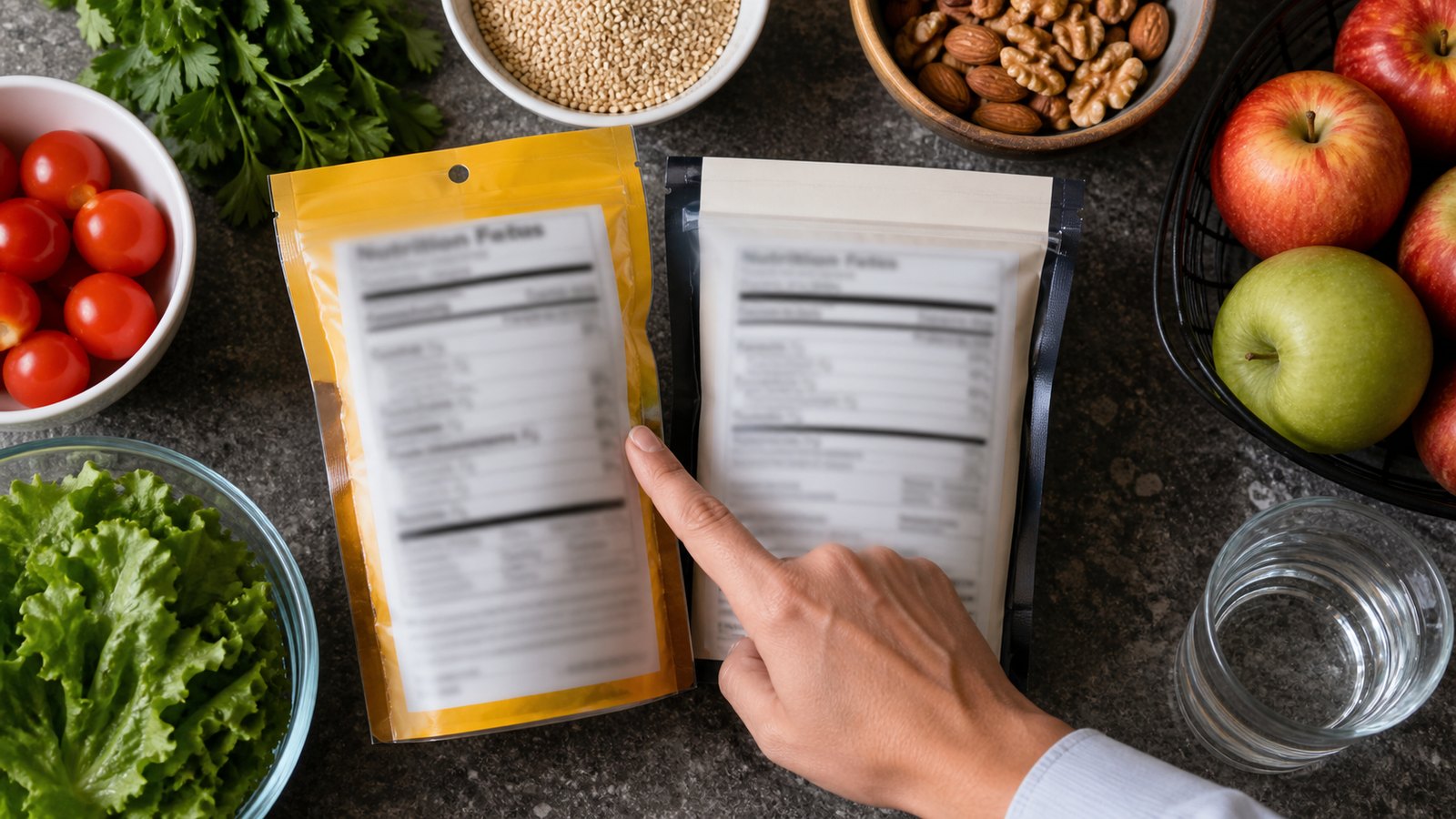
She knows she usually pours one full cup into a container rather than counting pieces. That cup is close to two servings of Bag A but roughly one serving of Bag B. Once she compares the amount she will actually pack, Bag A no longer has the apparent advantage. She then checks fiber, protein, sodium, ingredients, price, and which flavor she would enjoy. The label did not choose for her; matching the numbers to her container prevented a misleading comparison.
Find the few details that can change today’s choice
After aligning amounts, scan for the information relevant to the food’s job. Calories describe energy in the stated serving, but they cannot summarize the product. For a filling snack, someone might compare fiber and protein alongside calories. For a condiment, sodium and added sugars may be more useful differentiators because a small amount is meant to accompany other foods. This is a shopping method, not a universal nutrient ranking.
The percent Daily Value column offers a common reference point. It shows how much of the daily reference amount for a nutrient is represented by one labeled serving, based on the general daily intake used for labeling. It is best used for quick comparisons between like products and for noticing whether a serving contributes a little or a substantial share. It does not calculate an individual person’s needs, and the percentages still need adjustment when the eaten amount differs from the labeled serving.
Scenario two: Andre builds a ten-minute lunch
Andre wants a frozen grain bowl for days when meetings leave little cooking time. One option has fewer calories, but it is small and he expects to add another food. A second has more calories and also provides more fiber and protein. A third is similar in size but carries considerably more sodium than the others.
Instead of treating the lowest calorie count as the winner, Andre defines the job: the bowl should function as lunch with fruit he already brings. He compares full-container amounts because he will eat the whole package. He looks at calories for context, then at fiber, protein, sodium, and added sugars because those figures distinguish the three bowls. He also reads ingredients to see what makes each product different. His choice reflects the whole lunch and his preferences, not one isolated number.
Read the ingredient story after the numeric snapshot
The ingredient list answers a different question: what was used to make the food? Ingredients appear in descending order by weight, so the opening entries usually reveal the product’s basic character. This can clarify why two items with similar names have different panels. It can also uncover sweeteners, oils, grains, or flavoring components that are not obvious from the package front.
Allergen information deserves its own deliberate check when it matters to the shopper or household. Review the package each time rather than assuming a familiar product is unchanged. Manufacturing and ingredient statements provide information, but anyone managing a diagnosed allergy should follow guidance from an appropriate professional and the product manufacturer.
Scenario three: Lena compares pasta sauces for a family recipe
Lena needs sauce for a skillet meal that will make several portions. Jar A promotes vegetables on the front. Jar B emphasizes a traditional recipe. Those claims do not answer her practical questions, so she turns both jars around.
The serving quantities are the same, which makes comparison straightforward. Lena notices that Jar A has more added sugar and that Jar B has more sodium. The percent Daily Value column helps her see the relative size of each contribution without memorizing reference amounts. In the ingredient lists, tomatoes appear first in both, but their added ingredients differ.
Because the sauce will be divided across the dish, Lena estimates how much of each jar the recipe uses and how many plates it produces. She considers the unsalted beans and vegetables going into the skillet, the flavors her family accepts, and the prices. She chooses Jar B and plans the rest of the recipe accordingly. Another shopper with a different recipe or priority could reasonably choose Jar A.
Break ties with the package beyond the panel
When the nutritional differences are minor, let practical factors settle the choice. Check the net quantity, unit price, storage instructions, preparation required, and how quickly the food must be used after opening. A cheaper large package is not a bargain if part of it routinely spoils. A slightly different product may be worthwhile if it prevents an extra purchase or makes a realistic meal possible on a busy day.
Use a final basket check, not a perfect-food test
Before placing the package in the cart, summarize the choice in one sentence: “For the amount I will use, this option fits this meal because…” If the sentence depends only on a package slogan or a single number, take another look. If it accounts for portion, purpose, the few relevant nutrients, ingredients, and practical use, the comparison is probably sound.
Label reading becomes faster through repetition. You do not need to investigate every line during every trip. Define the food’s job, compare the amount you will actually use, inspect the details that could alter the decision, and consider the rest of the meal. That turns a dense panel into a focused shopping tool while leaving room for budget, enjoyment, culture, convenience, and personal priorities.