A bright yellow EnergyGuide label can turn a wall of similar refrigerators, washers, or water heaters into a useful comparison. It does not predict your exact utility bill or declare one model good or bad. Instead, it provides a standardized estimate for comparing products under the same test conditions.
Read the label in the right order. First confirm that the appliances are genuinely comparable. Then review estimated annual energy use, the comparison range, and estimated yearly operating cost. Finally, adjust the estimate for your local utility rate and household habits.
What the EnergyGuide label is designed to do
EnergyGuide is a federal labeling program for many categories of household appliances and equipment. Manufacturers use Department of Energy test procedures to develop the energy information, while Federal Trade Commission rules govern how required information is presented.
Start with the model number, size, and product class
Before comparing numbers, check the manufacturer, model number, appliance type, and capacity or size description. This prevents a common mistake: comparing products that are not designed to do the same job.
Capacity matters. A larger refrigerator has more space to cool, while a high-capacity washer can handle more laundry per load. A water heater’s storage volume or delivery characteristics affect whether it fits a household. Lower annual energy use is not automatically better if the appliance is too small and forces extra cycles or fails to provide the required service.
Read estimated annual energy use first
Estimated annual energy use is often shown in kilowatt-hours per year, abbreviated kWh/year, for electric appliances. This is the most portable figure because it describes energy consumption instead of a dollar estimate tied to an assumed utility rate.
Do not treat annual energy use as a promise. Room temperature, settings, load size, maintenance, installation, household schedule, and frequency of use can affect actual consumption. The label’s strength is consistency: comparable models are evaluated under the applicable procedure, making these figures more useful than informal efficiency claims.
Use the comparison range, not just the headline number
The horizontal scale places the model within a range for similar products. One end represents lower energy use or operating cost within the comparison group, while the other represents higher use or cost. The marker shows where that model falls.
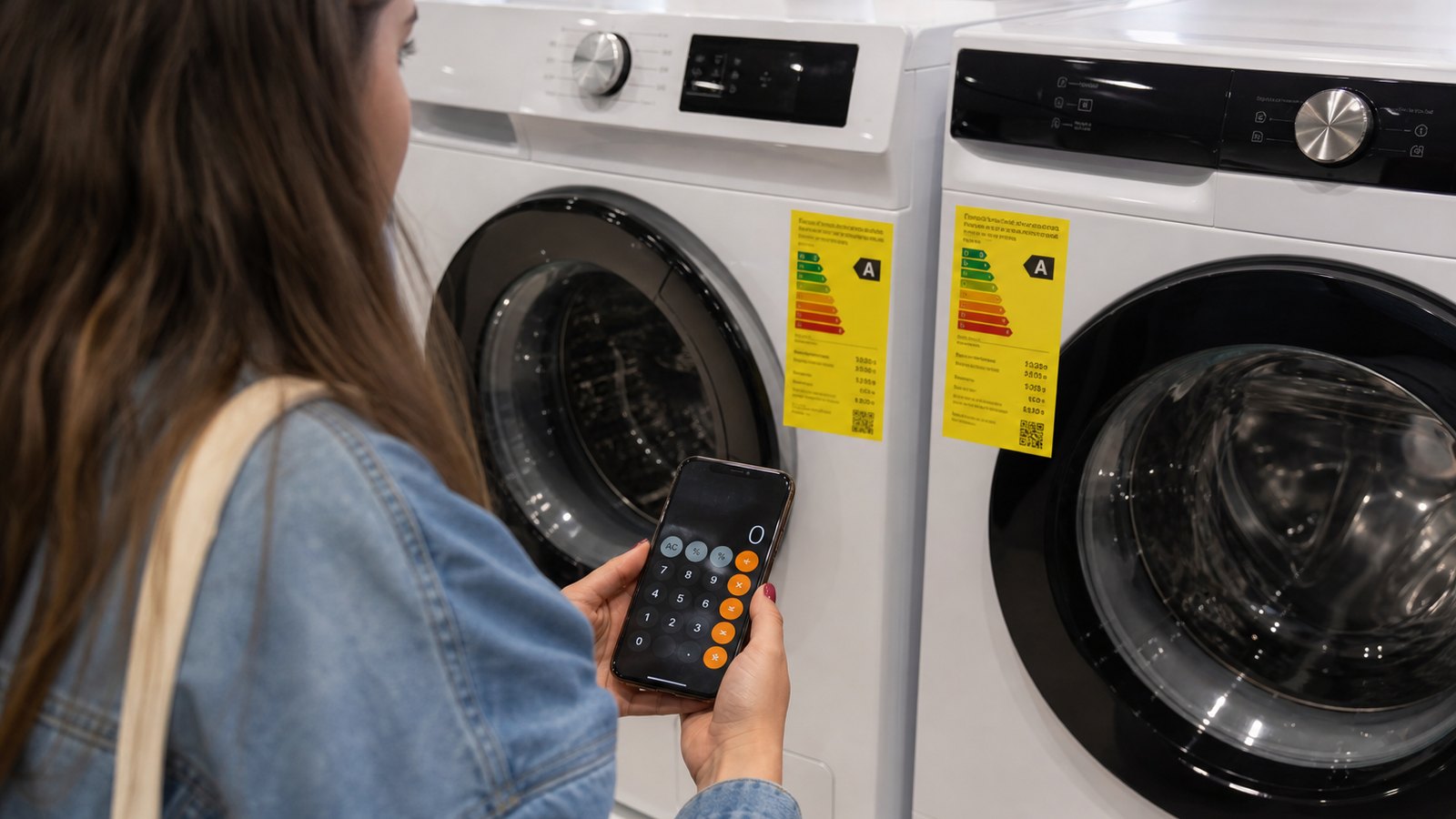
Read the comparison-group description carefully. Capacity ranges and key features may determine which models are included. If two labels describe different groups, their scales may have different endpoints. Compare the annual energy-use figures only after confirming that both appliances meet your needs.
Understand estimated yearly operating cost
Estimated yearly operating cost converts standardized energy use into dollars using an electricity, natural gas, or other energy-price assumption stated on the label. It is a planning figure, not a forecast of your bill.
Check the fine print for the assumed energy rate and usage basis. If your local rate is higher than the label’s rate, your likely cost will also be higher, all else equal. Utility-price changes over the appliance’s life can create an additional difference between the printed estimate and actual spending.
For an electric appliance, personalize the estimate with this formula:
Estimated local annual cost = annual kWh on the label × your local price per kWh
Find the price per kWh on a recent bill or your utility’s rate information. Tiered pricing, time-of-use rates, taxes, and seasonal adjustments can make one rate an approximation. Use the part of the bill that changes with consumption rather than assigning fixed monthly charges to one appliance.
EnergyGuide and ENERGY STAR are different
EnergyGuide and ENERGY STAR serve related but distinct purposes. EnergyGuide discloses estimated energy use or operating-cost information and supports comparison with similar products. Its presence does not mean an appliance is among the most efficient available.
ENERGY STAR is a voluntary certification program administered by the Environmental Protection Agency. A product displaying its mark has met efficiency specifications for that category. The logo may appear on or near the EnergyGuide label when a model qualifies.
Use both signals together. ENERGY STAR can identify models that meet current efficiency criteria, while EnergyGuide figures compare estimated consumption among suitable qualifying and nonqualifying products. Two ENERGY STAR certified models can still differ in capacity, features, and annual energy use.
Calculate lifetime operating cost
Purchase price is only part of an appliance’s cost. A model that uses less energy may offset a higher upfront price over years of operation. Compare finalists with a simple worksheet:
- Record each model’s annual energy use.
- Multiply it by your local energy rate to estimate one year of variable energy cost.
- Multiply that amount by the number of years you reasonably expect to own the appliance.
- Add the purchase price and relevant installation or required accessory costs.
- Consider maintenance, repairability, warranty coverage, and replacement risk separately.
Focus on the difference between models. Subtract the lower-use model’s estimated lifetime energy cost from the higher-use model’s estimate, then compare that potential savings with the purchase-price difference. This shows whether paying more upfront appears reasonable for your ownership period. Because energy prices and usage can change, treat the result as a scenario rather than guaranteed savings.
Account for the way your household uses appliances
Standardized estimates cannot capture every routine. A second refrigerator in a hot garage may use more energy than the same model in a conditioned kitchen. A washer running many small loads may consume more annually than one used for fewer full loads. Water-heating cost depends heavily on demand, temperature settings, and incoming water temperature.
Think through your routine before choosing the lowest label number. An appliance that matches your capacity needs may reduce unnecessary cycles or overflow to another machine. Efficient behavior and correct sizing work together; neither replaces the other.
A practical purchase checklist
Use this checklist in a store or while comparing product pages:
- Confirm identity: Match the label’s model number to the exact appliance being sold.
- Match the job: Compare the same product type, configuration, capacity, and essential features.
- Record annual use: Note kWh/year or the relevant efficiency measure for each finalist.
- Read the range: See where the model sits among the similar products described on the label.
- Find the assumptions: Note the energy rate and usage basis behind estimated annual cost.
- Adjust locally: Recalculate electricity cost with the variable per-kWh rate from a recent bill.
- Check ENERGY STAR status: Treat certification as an efficiency qualification, not a substitute for comparing figures.
- Estimate ownership cost: Combine purchase price with a reasonable lifetime energy scenario.
- Consider fit and installation: Confirm dimensions, connections, ventilation, and capacity suit the home.
- Review use habits: Account for load frequency, settings, climate, placement, and maintenance.
- Save the data: Keep a photo or written record for comparisons after leaving the store.
Make the label support the decision
The best use of an EnergyGuide label is not chasing the smallest number at any cost. It is narrowing the choice to appliances that fit your household, then estimating how energy use may affect ownership cost.
Compare like with like, rely on annual energy use for local calculations, and treat printed operating cost as an estimate based on stated assumptions. Add ENERGY STAR status, purchase price, expected life, installation, and everyday usage. That turns a yellow label from fine print into a practical buying tool.